Every team has its own definition of a deal
Stages, record types and required fields multiply until pipeline reviews become inconsistent.
Salesforce can support detailed sales operations, but complexity becomes expensive when the data model, permissions and automations are not governed. Techcruz helps map business requirements into a maintainable implementation plan.
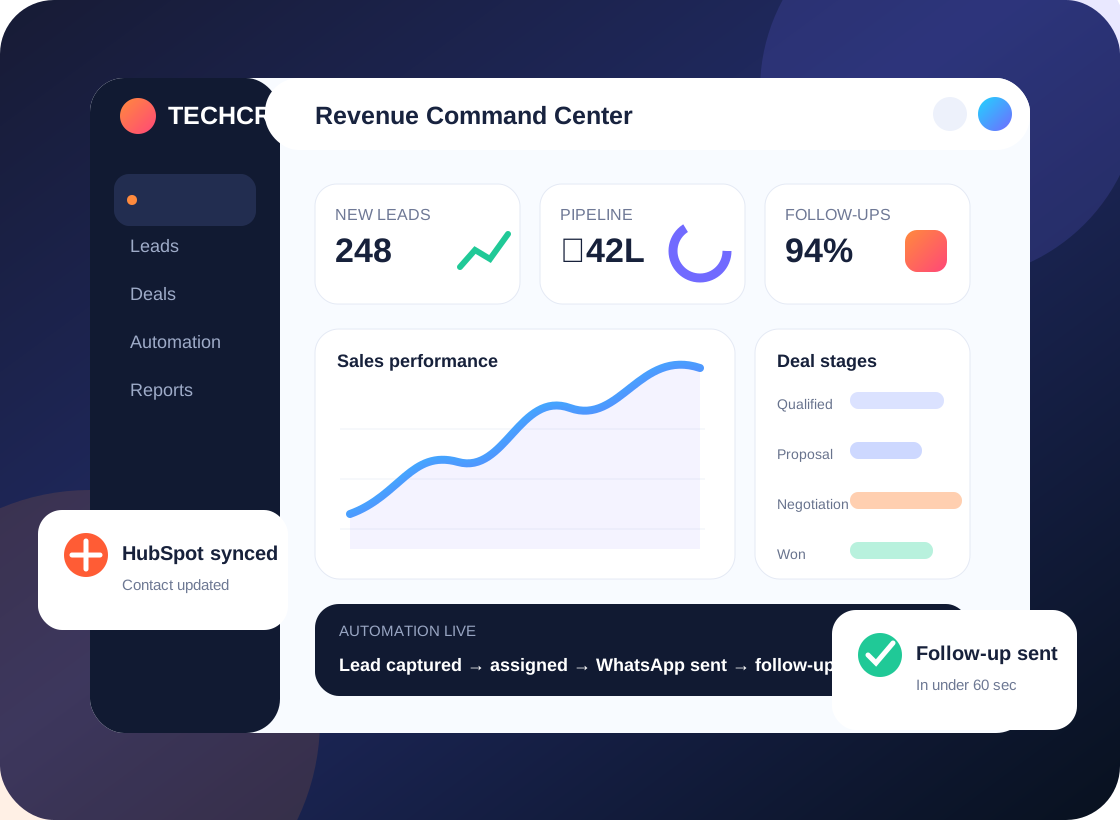
Less chasing. More visibility.
Salesforce CRM • Process design • Configuration and change control
Most CRM frustration begins before anyone opens a dashboard. These are the day-to-day gaps we look for in a discovery session.
Stages, record types and required fields multiply until pipeline reviews become inconsistent.
Automations or permission changes affect existing workflows because dependencies were not identified and tested.
Leadership cannot easily compare forecast categories, owner activity and opportunity movement across teams.
Records are split across tools, follow-ups depend on memory and sales managers piece together updates after the fact.
We focus on ownership, clear object relationships, sensible automation and reporting that can be maintained after launch.
We connect the business goal to the CRM configuration. These are the practical workstreams that can be included after a requirement review.
Map how leads, accounts, contacts and opportunities relate to your actual sales workflow.
Review standard configuration before adding custom objects, record types and validation rules.
Scope lead routing, approvals, reminders and record updates with testing of exception paths.
Document who needs to view, create and edit each type of information, with appropriate security review.
Assess source data, APIs, field mappings and controls before connecting external systems.
Define success scenarios, dashboards, user acceptance tests and admin documentation.
Tell us which part of the process is failing. We can start with a focused audit instead of a full rebuild.
Illustrative architecture, to be adapted to your actual Salesforce edition and configuration.
Lead data enters through an approved source and is validated.
Clear rules identify an accountable owner and next step.
Opportunity stages reflect meaningful business milestones and approval needs.
Auditable reporting and tested changes support predictable operations.
Illustrative process only; not a claim about a specific completed Techcruz customer project.
Different businesses need different sales stages, customer context and approval rules. Here are examples of teams that may benefit from this approach.
Clarify complex deal stages, stakeholders and forecast visibility.
Plan consistent account, contact and opportunity records across departments.
Review unnecessary fields, overlapping automation and difficult-to-maintain processes.
Our homepage emphasizes a simple five-stage approach. The purpose is to make requirements, responsibilities and acceptance visible throughout the project.
Clarify outcomes, current systems, sales roles, pain points and important exceptions.
Agree fields, lead ownership, workflow logic, reporting questions and acceptance tests.
Configure the agreed CRM features and supported integrations in the appropriate environment.
Walk through realistic scenarios with users, fix issues and document the daily process.
Release agreed changes, collect feedback and define support or next-phase improvements.
Supply existing process maps, Salesforce edition, users/roles, key object definitions, automation inventory and the most painful reporting or ownership issues.
Requirements and delivery arrangements confirmed during consultation. Timing, pricing and platform capabilities are confirmed in the agreed scope.
The original Techcruz homepage includes case-study materials, selected review screenshots and professional certification resources. Review them alongside the proposed scope for your own project.
Clear expectations make implementations easier to manage. These answers outline practical considerations, not a substitute for checking your actual software and requirements.
Work can begin with a scoped review of configuration, data model, permissions and existing automation. Any changes should be tested and approved before production deployment.
Prefer configuration that meets the business requirement cleanly; code may be justified when supported platform features are insufficient. The decision requires technical scoping.
Integration feasibility depends on the external system, APIs, security requirements, licensing and expected data volumes.
A migration or cleanup plan can define matching rules, validation, test imports and review procedures.
Document scope, review dependencies, use a suitable testing environment, obtain acceptance and plan a rollback strategy for material changes.
Tell us what happens today, what keeps getting missed and which CRM or connected systems your team uses. We'll start by understanding the workflow before suggesting a solution.
Share your current platform, goal, lead sources and biggest issue. No one-size-fits-all build is assumed.
Message Techcruz on WhatsAppUse the website enquiry form