Software purchased, process unchanged
A CRM is deployed with default stages, but salespeople keep using personal spreadsheets and managers continue asking for manual updates.
Whether you are moving from Excel or replacing an underused CRM, Techcruz helps define what sales teams must capture, who owns the next action, which tasks can be automated and what leadership needs to see.
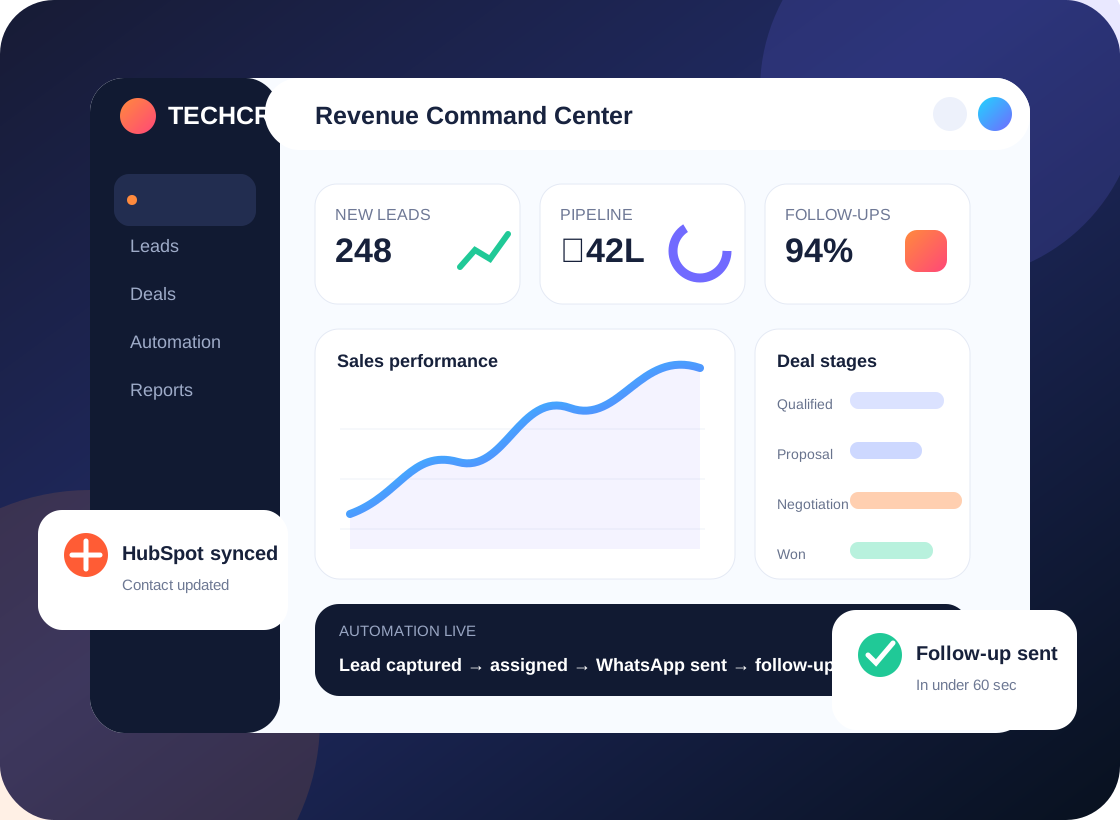
Less chasing. More visibility.
CRM strategy • Setup • Automation • Adoption
Most CRM frustration begins before anyone opens a dashboard. These are the day-to-day gaps we look for in a discovery session.
A CRM is deployed with default stages, but salespeople keep using personal spreadsheets and managers continue asking for manual updates.
Website forms, campaigns, email and service tools create duplicate records or require repeated manual entry.
Without agreed qualification rules and ownership, dashboards look complete but fail to reflect what is happening on the ground.
Records are split across tools, follow-ups depend on memory and sales managers piece together updates after the fact.
We translate current sales activity into a practical configuration, validate real scenarios with users and leave the team with an understandable operating process.
We connect the business goal to the CRM configuration. These are the practical workstreams that can be included after a requirement review.
Document users, customer types, pipeline stages, lead sources, bottlenecks and important reporting questions.
Compare available platform features against business needs, integrations, scale and the level of customization required.
Set up records, fields, pipelines, permissions, views, activities and clear ownership rules.
Build follow-up reminders, routing, approvals and notifications with exception handling and test cases.
Plan connected systems, map existing data and validate record movement and sync behavior.
Train sales and management users on daily workflows and define support and change-request processes.
Tell us which part of the process is failing. We can start with a focused audit instead of a full rebuild.
Example implementation journey; actual steps are agreed during discovery.
Combine approved enquiries from forms, campaigns and existing data.
Use required fields and agreed criteria to understand fit and urgency.
Assign the deal, schedule next steps and track movement through a real pipeline.
Show conversion by source, owner and stage so managers can identify bottlenecks.
Illustrative process only; not a claim about a specific completed Techcruz customer project.
Different businesses need different sales stages, customer context and approval rules. Here are examples of teams that may benefit from this approach.
Move from founder-led follow-ups to an accountable team workflow without unnecessary complexity.
Standardize lead ownership, access and reporting across cities or territories.
Manage enquiry, quotation, onboarding and renewal visibility with a connected process.
Our homepage emphasizes a simple five-stage approach. The purpose is to make requirements, responsibilities and acceptance visible throughout the project.
Clarify outcomes, current systems, sales roles, pain points and important exceptions.
Agree fields, lead ownership, workflow logic, reporting questions and acceptance tests.
Configure the agreed CRM features and supported integrations in the appropriate environment.
Walk through realistic scenarios with users, fix issues and document the daily process.
Release agreed changes, collect feedback and define support or next-phase improvements.
A useful starting pack includes your current sales stages, spreadsheet/CRM export examples, users and roles, required integrations and the reports your leadership currently struggles to produce.
Requirements and delivery arrangements confirmed during consultation. Timing, pricing and platform capabilities are confirmed in the agreed scope.
The original Techcruz homepage includes case-study materials, selected review screenshots and professional certification resources. Review them alongside the proposed scope for your own project.
Clear expectations make implementations easier to manage. These answers outline practical considerations, not a substitute for checking your actual software and requirements.
We compare process complexity, user needs, integration requirements, licensing, scalability and maintenance trade-offs. A shortlist should follow discovery rather than precede it.
It can be phased to reduce disruption. A pilot pipeline, data import tests and a controlled transition help protect daily operations.
The first period should include user feedback, issue resolution, monitoring and incremental improvements. The precise support arrangement needs to be agreed in scope.
In many cases, yes. Feasibility depends on data access, available exports or APIs, mapping and cleansing needs.
Cost depends on users, modules, integrations, data quality, automation complexity and training. A detailed requirement review is needed before quoting responsibly.
Tell us what happens today, what keeps getting missed and which CRM or connected systems your team uses. We'll start by understanding the workflow before suggesting a solution.
Share your current platform, goal, lead sources and biggest issue. No one-size-fits-all build is assumed.
Message Techcruz on WhatsAppUse the website enquiry form