Your tools do not share customer context
Marketing forms, meeting bookings, email and sales records create fragmented handoffs that slow response and qualification.
If your team is struggling with inconsistent follow-ups, disconnected applications or a CRM no one enjoys using, Techcruz can discuss a clearly scoped remote implementation project with your US-based business.
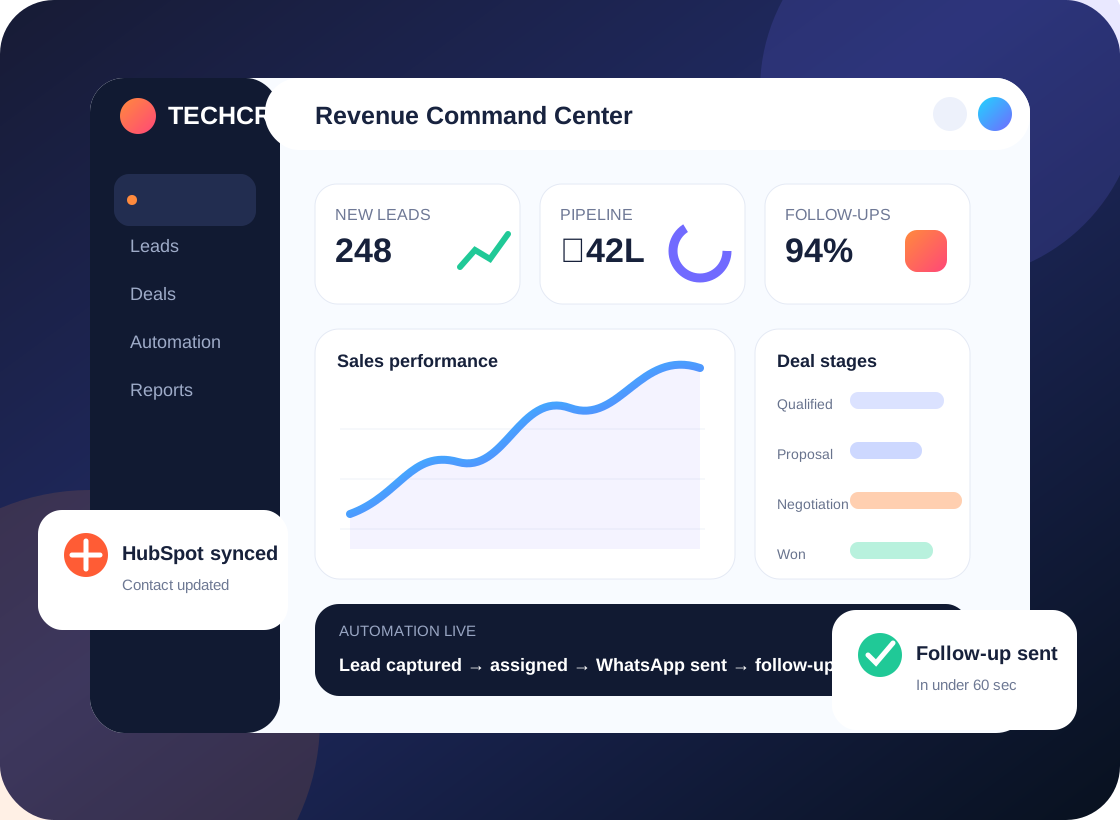
Less chasing. More visibility.
India-based service delivery • US-team collaboration
Most CRM frustration begins before anyone opens a dashboard. These are the day-to-day gaps we look for in a discovery session.
Marketing forms, meeting bookings, email and sales records create fragmented handoffs that slow response and qualification.
Salespeople enter the same details repeatedly and managers still ask for manual forecast spreadsheets.
Without clear requirements, access controls and review checkpoints, offshore implementation can feel unpredictable.
Records are split across tools, follow-ups depend on memory and sales managers piece together updates after the fact.
We organize remote CRM work around defined deliverables and visible checkpoints so stakeholders can see how the system will operate before accepting it.
We connect the business goal to the CRM configuration. These are the practical workstreams that can be included after a requirement review.
Document current CRM, key problems, stakeholders, measurable goals and acceptance conditions.
Set up pipelines, users, record structure, ownership and activity rules for the agreed platform.
Plan supported workflows between CRM, lead sources, scheduling and approved external tools.
Map existing records, audit duplicates and define a safe import or migration sequence.
Review workflows through shared demonstrations, test scenarios and written feedback.
Provide agreed configuration notes, process guidance and any post-launch support scope.
Tell us which part of the process is failing. We can start with a focused audit instead of a full rebuild.
Example collaboration approach; actual meeting times and service availability are agreed with the project team.
Share your current process, CRM access requirements and primary pain points.
Review a proposed configuration and agreed outcomes before changes begin.
Test lead routing, automation and dashboards in relevant scenarios.
Approve agreed deliverables and document responsibilities for next steps.
Illustrative process only; not a claim about a specific completed Techcruz customer project.
Different businesses need different sales stages, customer context and approval rules. Here are examples of teams that may benefit from this approach.
Make lead ownership and sales activity visible without unnecessary platform complexity.
Discuss outsourced technical CRM delivery to support your customer projects.
Standardize a common pipeline, reporting definitions and handoff rules.
Our homepage emphasizes a simple five-stage approach. The purpose is to make requirements, responsibilities and acceptance visible throughout the project.
Clarify outcomes, current systems, sales roles, pain points and important exceptions.
Agree fields, lead ownership, workflow logic, reporting questions and acceptance tests.
Configure the agreed CRM features and supported integrations in the appropriate environment.
Walk through realistic scenarios with users, fix issues and document the daily process.
Release agreed changes, collect feedback and define support or next-phase improvements.
Share your preferred collaboration hours, CRM subscription, systems to integrate, user roles, data sensitivity requirements and decision-makers for acceptance.
Remote service—no local office is claimed. Timing, pricing and platform capabilities are confirmed in the agreed scope.
The original Techcruz homepage includes case-study materials, selected review screenshots and professional certification resources. Review them alongside the proposed scope for your own project.
Clear expectations make implementations easier to manage. These answers outline practical considerations, not a substitute for checking your actual software and requirements.
This page describes remote CRM delivery to US customers; it does not claim Techcruz maintains a US office. Confirm company and invoicing information directly before engaging.
Scheduling expectations should be discussed during discovery. Availability depends on the agreed project and working arrangement.
Before granting access, agree permissions, data handling expectations and any contractual requirements. Use least-privilege access and suitable test data where practical.
The scope may include audit, cleanup, automation or configuration within an existing CRM rather than a full replacement.
Use documented requirements, demonstrations, test cases, review checkpoints and written acceptance criteria set in the project scope.
Tell us what happens today, what keeps getting missed and which CRM or connected systems your team uses. We'll start by understanding the workflow before suggesting a solution.
Share your current platform, goal, lead sources and biggest issue. No one-size-fits-all build is assumed.
Message Techcruz on WhatsAppUse the website enquiry form